

ZIGNAGENIX · ADVANCED REGENERATIVE MEDICINE
Precision regenerative therapy harnessing the body’s own elite repair system — targeting damaged tissue, reducing inflammation, and restoring function at the cellular level.
Year of Discovery
Dr. Mari Dezawa, Tohoku University
Germ Layers MUSE Cells Can Differentiate Into
Reported Teratoma
Formations Across All Studies
Completed Clinical Trials
(AMI, Stroke, ALS, SCI & More)
Billion Dezawa Muse Cells Administered.

DISCOVERY & BIOLOGY
MUSE cells — Multilineage-Differentiating Stress-Enduring cells — are naturally occurring pluripotent stem cells discovered by Dr. Mari Dezawa at Tohoku University in 2010. Residing in bone marrow, peripheral blood, and connective tissue, they are the body’s own elite repair system.

Found throughout the body, MUSE cells are not engineered or modified. They are mobilised and amplified from the patient's own biological environment, supporting true healing at the cellular level.

Injured cells release sphingosine-phosphate (S1P). MUSE cells detect this distress signal via their S1PR receptor and migrate directly to the damage site — targeted repair without cytokine pretreatment or gene modification.

Low telomerase activity and Let- microRNA expression suppress uncontrolled growth. No teratoma formation has been observed across any published study — a safety profile unmatched in regenerative medicine.
SAFETY & MECHANISM

MUSE cells generate cells from all three germ layers — ectoderm, mesoderm, and endoderm — from a single cell. They can differentiate into neurons, cardiac cells, hepatocytes, renal cells, and more.
MUSE cells survive hypoxia, nutrient deprivation, and cytotoxic conditions where standard stem cells fail — remaining active at
injury sites long enough to drive meaningful repair.
A 2024 landmark study confirmed MUSE therapy can be delivered across donor- recipient pairs without HLA-matching or immunosuppressant drugs — simplifying treatment and broadening patient eligibility.

T H E R A P E U T I C A P P L I C A T I O N S
MUSE cell therapy is supported by published clinical and preclinical evidence across multiple organ systems.
IV-administered MUSE cells show measurable ejection fraction improvement after ischemic damage. First human trial: EF improved
~41% → 52% at 3 months.
Targeted cellular support to slow decline in early-to-moderate renal disease. Preclinical models confirm MUSE cell integration into glomerular
structures.
MUSE cells differentiate into functional hepatocytes and directly replace damaged liver tissue, targeting inflammation-driven hepatic decline.
IV MUSE cells alleviate acute pancreatitis and support pancreatic stability
without requiring immunosuppression.
2023 RCT demonstrated significantly greater motor recovery vs. placebo
at 4 weeks, sustained at 12 months.
Supports whole-body cellular repair, reduces systemic oxidative stress, and improves physiological balance — harnessing MUSE cells’
homeostatic properties for healthy aging.
Schedule your concierge consultation to learn whether MUSE cell therapy is right for your condition.
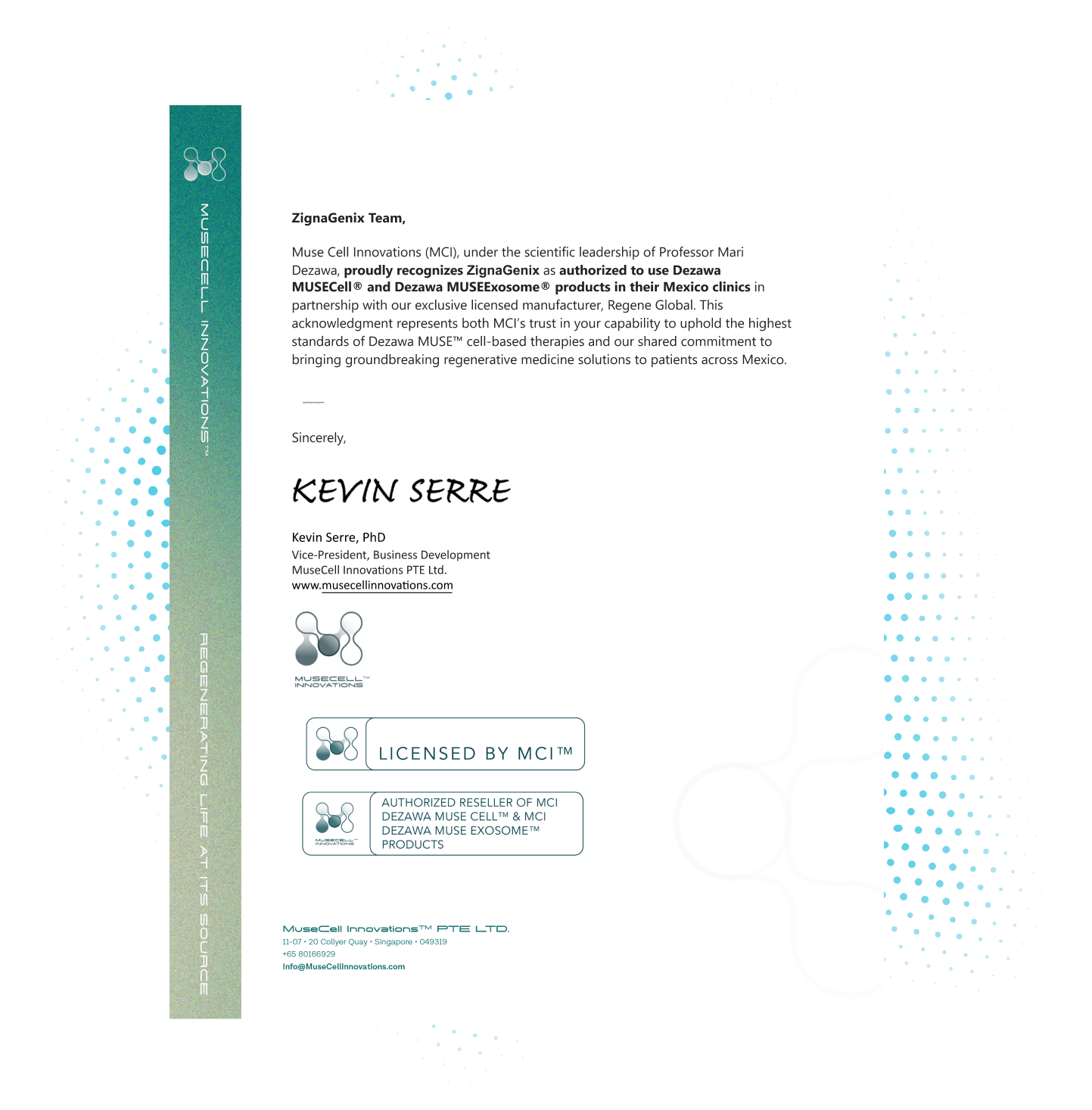
The oversight of the development, production, and use of the therapy in clinical settings is governed by existing intellectual property frameworks that protect the MUSE cell technology. The therapeutic use of MUSE cells is licensed worldwide through authorized programs that meet structured standards for quality and application.
Because of this controlled model, access to the therapy is limited to approved providers who operate under defined clinical and operational guidelines. This helps to ensure consistency in the treatment process and adherence to validated protocols.
This regulated distribution ensures:

ZignaGenix brings patients into the care of physicians with strong experience in regenerative medicine and complex case planning. Every treatment begins with a close review of the patient’s health history, goals, and clinical needs before any therapy is recommended.
Patients are supported through a structured process from consultation to follow-up. Patients are taken through evaluation, preparation, and follow-up with clear communication and ongoing monitoring, creating the sense that every step is organized, safe, and medically directed.

You begin with a detailed review of your medical history, symptoms, and treatment goals. This gives our team the information needed to decide whether MUSE cell therapy fits your health needs.
Your therapy is completed in a controlled clinical setting. MUSE cells are administered through the chosen method to help support repair activity in areas affected by stress or damage.
After your evaluation, we create your personalized plan that is tailored to your condition and recovery goals. We detail the treatment method, schedule, and support plan so you know what to expect.
Your care doesn’t end at the end of the session. It continues with follow-up and monitoring of your progress. The team monitors your response and helps guide you through the next stage of recovery.
Speak with our team to find out whether MUSE therapy is the right next step for your recovery.
Many patients who trusted ZignaGenix report life-changing improvements. Some have regained mobility after years of chronic joint pain, while others feel renewed energy and reduced inflammation. These inspiring stories highlight the possibilities waiting for you when you choose the right clinic.
15 Years of Lyme Disease Pain –
How Stem Cells Gave Me Relief
How I Regained My Ability to
Walk Without Pain | ZignaGenix
What to Expect at ZignaGenix
Stem Cell Therapy
Breathing New Life: Patient No Longer Needs Breathing Tube
78-Year-Old Renee Finds
Hope for Chronic Pain & Autoimmune
Disorders with Stem Cell Therapy
Stem Cell Therapy for Herniated Discs – My Alternative to Neck Surgery